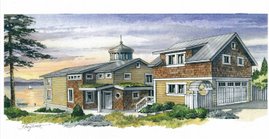
A Beacon for the Future

A Beacon for the Future
"We hope the reinvention of our 100-year-old waterfront home as a model of green building will educate and inspire both the building industry and the general public.” - Homeowners Dave and Anna Porter (rendering by Craig Thorpe).

Monday, April 16, 2012

Pervious Concrete & Permeable Pavers

One of the things that we pride ourselves on here at GGATB is that we have effectively reduced significantly our storm water runoff. Why is this important?  First of all, every time we humans erect a building or lay pavement we alter the natural hydrological cycle.  The way it's supposed to work is that when rain falls, about 50% of it infiltrates back into the soil and underlying aquifer, 40% gets absorbed back into the air through evapotranspiration, and only about 10% is actual "runoff." See the graphic below:
 

Source: www.aucklandcity.govt.nz

But once we start filling up land with buildings and pavement, that natural cycle gets circumvented.  In a city where you could have 75-100% impervious surfaces (hard surfaces like buildings and roads that don't absorb water) the infiltration is reduced to a mere 15% and up to 55% is now runoff.

And why is that a problem?  Well, first of all, all that water needs somewhere now to go.  Which means that cities have to figure out ways to transfer it off of the streets into storm drains.  Stormwater management is one of the most costly and troubling issues that cities face:  Where to send it, how to treat it, etc.  Second, all that stormwater now carries in it all the pollutants that were sitting around on roadways or chemicals from landscaping, etc.  The water is no longer safe to send back into the aquifer or out to streams, rivers, and oceans.  It has to be treated somehow.   But that's only the water that is actually collected in storm drains.  There is a significant amount of water that just runs off into local bodies of water, taking with it poisons that wreak havoc on the marine life and potable water sources. 

So back to GGATB...we are particularly sensitive to storm  water runoff since most of it would go straight into the fragile Puget Sound right outside our door.  We opted for pervious concrete which is basically concrete without the sand.  It has a texture like a Rice Krispies Treats© and those spaces between the solids allow water to percolate right through.  Our pervious concrete is about 4" thick and lays on top 18" of sand, gravel and broken up recycled conventional concrete that came from the old foundation of the cabin.  This substrate gives the water somewhere to go as it trickles down through and back into the aquifer below.  The permeable pavers work in a similar fashion.  They are designed in such a way that there are spaces between them.  They also sit on an 18" substrate so that water can go down between them into the ground.

How's it working?  Great!  After more than 4 years with only 2 power washings (which we hate to do because it uses so much potable water!  Would that some company would come up with a way to use greywater for power washing!) the pervious concrete is happily sucking up all the storm water that nature can throw at it.  Some folks have asked about the impact of freezing.  We do get some significant freezing periods (up to a week at times) but this has not caused any problems that we can see.  Neither does sand or dirt.  Even though we live at the beach and a good deal of sand get traipsed up from the shore it doesn't seem to inhibit the concrete abilities at all.  So far so good.

Likewise for the permeable pavers.  The spaces between make for great little micro-gardens for sedums spreading from the green roof, moss (a Pacific NW perennial!) and the occasional weed but even if we let these take root they don't diminish the permeability.  No standing water or rivers of water on this property!

For more on storm water mitigation and issues watch the educational videos at our PorterWorks YouTube channel: http://www.youtube.com/user/PorterWorks/videos?sort=dd&view=0&page=2.


Tuesday, June 28, 2011

Long Awaited Update

Sorry to be silent so long friends!  Lots have been happening at the beach but recently we had a new opportunity to test out one of our green building schemes: universal design.  The whole idea of universal design is that a home is built for life and built for anyone to live in.  This means that the home will function well regardless of someone's physical capabilities.  What makes this a green concept (even though it is not necessarily part of green building checklists) is the idea that the home is built for life or "aging in place."  If we can build one home to last throughout a lifetime that eliminates the need to build many homes for many different stages of life, hence saving on materials, energy and environmental impacts.

At Going Green at the Beach we tried to incorporate some of these concepts at least on the main floor.  Getting to the main floor is a challenge for the physically impaired but once inside the house much of the first floor is accessible by wheelchair and/or walker.  I got to experience that first hand.  And I didn't have to wait until I was "elderly." On May 23, at the ripe old age of 53, I suffered a hemorrhagic stroke which paralyzed my right foot, leg, arm and hand.  After 3 days in CCU I was transferred to inpatient rehab for 3-1/2 weeks and discharged with a wheelchair, a walker and instructions for my family on how to help me get around, shower, dress, etc.  I had made great progress in rehab but still needing to use DME (durable medical equipment).

How glad we were--and how impressed my therapists and doctors were--that we had made the decision to incorporate universal design concepts into our home.  That meant there were very few changes that had to be made to accommodate my safe homecoming.  We already had installed a Kohler shower with low threshold, built-in grab bars, built-in bench and hand-held shower head.  Also, in the main floor bath we have a pedestal sink for easy access and enough room to turn a wheelchair around easily.  We had also planned ahead during the framing stage to install a beam as a backer board so that installing a grab bar for the toilet was painless.  If this had been a permanent situation (thankfully it appears not to be!) we would have also been able to easily install a pocket door between the bathroom and what was the office as we had also during framing installed the pocket door frame.  Throughout the rest of the main living level we had, at our interior design consultant Keith Miller's advice, our light switches located lower so they are reachable at wheelchair height.  The same is true of our Sharp microwave drawer which is located in the side of the kitchen island for access at a lower height.  The office was quite easily converted to a bedroom for me and the extra-wide hidden doorway is helpful for wheelchair access.  And of course, the use of only hard-surface flooring makes wheelchair and walker mobility much easier.

The things that we had to install after the fact:  an additional handrail down the stairs from the street level to the front porch and the grab bar by the toilet.  What we could have done differently?:  Install those remote controlled switches for the ceiling fan/lights which I thought were unnecessary but now would really appreciate the ease of controlling my own fan/light and find a way to make the doorway to the bathroom wider (the wheelchair fits through but just barely) or pull-away hinges.  Overall, the plan has worked well.  Especially since we have help with the laundry which is on the second floor and inaccessible to me as yet!

Thursday, February 5, 2009

So What Does It Really Cost/Save in Energy?

I know we have promised you, dear reader, some news about how well our home is performing on energy consumption but this turns out to be harder than it seems! We have now lived in the home for more than a year so we finally have a year's worth of power and propane bills collected. We're actually probably doing well overall in terms of cost. Since we honestly don't know how our house compares to non-"green" homes this size, we really don't know how much our bills should be. We also have some potential power hogs (i.e. a hot tub and a steam unit). We do know that our heating system--typically the biggest consumer of power in a home--uses very little power at all.  So that helps a great deal.  Technically, if we had a standard HVAC system our bills could be nearly double!

We can say that our little 1.2 kW solar power system did indeed produce 1,000 kWh over the first year in service. While that is not a lot, it most likely covered the power needed to run our geothermal ground source heat pump.

More coming soon!

Thursday, August 28, 2008

So How Much More Does Building Green Cost?

Dear Readers:
I get asked this question (or some variation of it) frequently (and in fact was "misrepresented" in an interview with The Wall Street Journal where they shrunk what I said to imply that the cost is outrageous!) and I find answering it quite difficult.

Here's my response to a recent query about "how much the renovations cost.":

"So…your question was how much the “renovations” cost. This is a tough question. Because the cost of our project is impacted by many factors—not all of them “green.” First of all, this is a very custom home: we’re talking things like very custom millwork and a 10K custom hand-crafted glass mosaic breakfast bar and a cupola and custom-made metal stairs. Things like that. Also, we chose very nice features—not necessarily always just the affordable option. Secondly, this was a demonstration home which meant that it had to be built on a schedule and it had to be, well, perfect. It was going to be on show. We also paid for the services of a marketing manager, a website designer, marketing materials, educational materials, etc. Those things contributed to the cost. Thirdly our building project was, well, our building project. That is to say, we had our own special set of circumstances that impacted cost: size, location and accessibility of the lot; the fact that it was custom and required an architect; the fact that based on the location and the amount of glazing we wanted—and that little thing called a cupola--required the services of an engineering firm. We also went for 5 certifications which required the services of a green construction professional whose only job was to make sure we were meeting those requirements. That cost more money. We also had help from sponsors (no, we did not get our house for free or even close!) but that often meant that we ended up spending more $$ because we went with their products instead of really shopping around. A good example is Kohler. They were kind enough to sponsor us (which means they cut us a significant break) but demanded that they be the only plumbing supplier. And Kohler is not only expensive but installation of Kohler products is more expensive.

See what I mean? So when people ask me how much more our house cost because it is green that’s not such a straightforward question. Here’s an example: our no-VOC paint by American Pride retails for $39/gallon. We could have purchased: )a Benjamin Moore that wasn’t green for about the same price; or b) we could have purchased a much cheaper non-green option at Home Depot. So against which should I make the $$ comparison? Another example: We went with all hard-surface flooring partly due to our American Lung Association Health House requirement (and because we personally think carpet is gross!). Our bamboo, and cork, and FSC teak and Marmoleum could be considered more expensive compared to inexpensive carpet and vinyl but in terms of general quality I think they compare more to a pricier carpet option. So, again, against what are we making a comparison?

Could we have built our home cheaper by not paying attention to quality or greenness? Absolutely! But we wanted to build the house we wanted, we wanted it green and we wanted it to be good quality that would last—an important component of green building.

Sorry for the diatribe—and for not really answering your question (no, I was not a politician in a former life!) But hopefully this will help you understand the difficulty in answering your seemingly innocuous question."


Cheers!